
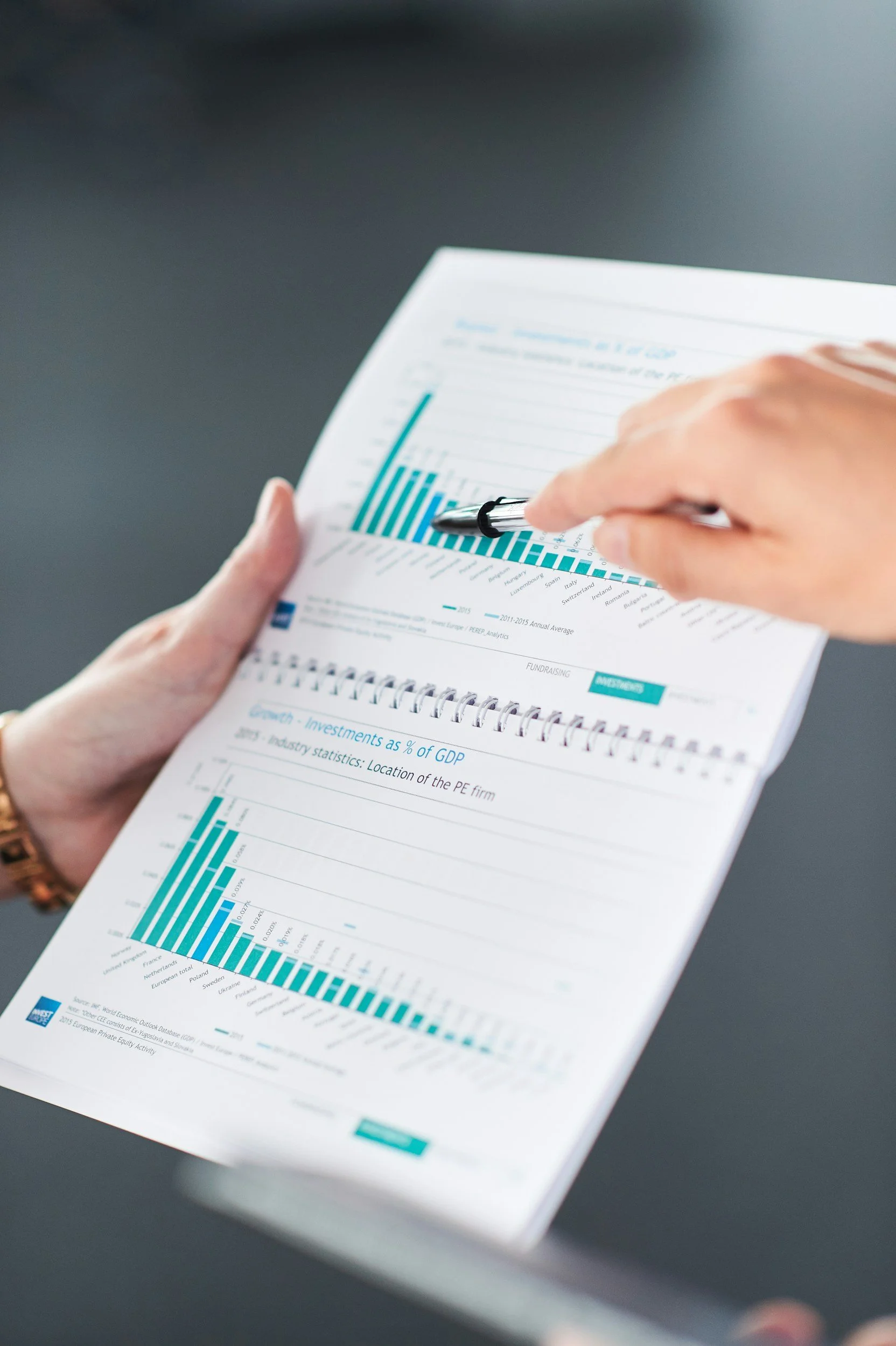
Three letters turn up in almost every economic story you will ever read. "GDP grew 0.4 per cent last quarter." "The economy is slowing as GDP growth stalls." "The country has entered recession after two quarters of falling GDP." Presenters say it with the confidence of people who assume everyone already knows what it means. Plenty of smart, curious people do not, and there is nothing embarrassing about that, the term is used far more often than it is explained.
GDP stands for gross domestic product, and it is the headline measure of the size of an economy. More precisely, it is the total value of all the goods and services a country produces over a set period, usually measured every three months (a quarter) and every year. Coffees sold, houses built, haircuts given, software written, cars manufactured, consultations billed, add up the value of everything a country makes and sells, and you have GDP. It is the closest thing economists have to a single number for "how much did the economy do this year."
Why anyone cares about one number
On its own, the raw figure is enormous and hard to feel. What everyone actually watches is the change in GDP, whether it is growing, and how fast. Growth means the economy is producing more than it did before, which usually goes hand in hand with businesses expanding, more people in work, and more money moving around. When GDP shrinks, the opposite tends to be true: activity is contracting, and jobs can become harder to find.
This is why GDP moves markets and dominates the news. It is a scorecard for the whole economy, and almost everything in finance is downstream of it. When the economy is growing, companies tend to sell more and profits rise, which supports share prices. When growth slows, investors get nervous, and policymakers start paying close attention. Governments use GDP to judge whether their policies are working; central banks use it to help decide what to do with interest rates, which we unpacked in our explainer on what the RBA is responsible for.
The word that scares everyone: recession
You cannot talk about GDP without meeting its gloomier cousin. A recession is, by the most common rule of thumb, two quarters in a row of falling GDP, the economy getting smaller two three-month periods back to back. It signals that activity is contracting rather than expanding, and it is why the GDP release each quarter is watched so closely: people are checking whether the economy is still moving forwards. We have a fuller piece on what a recession is if you want to go deeper, but the key link is simple: recession is defined in terms of GDP, so once you understand GDP, recession stops being a scary abstract word and becomes something you can actually picture.
What GDP is made of
It helps to know roughly what goes into the number, because it explains why certain news stories matter. Economists usually describe GDP as the sum of a few big pieces: what households spend (consumption), what businesses invest (new equipment, buildings and the like), what governments spend, and the balance of what a country sells overseas versus what it buys in (exports minus imports).
That breakdown is why a story about consumers tightening their belts, or businesses pausing investment, or a fall in exports, all get reported as threats to growth. Each is a component of GDP. When you see a headline about retail spending sliding, you are really reading about one of the engines of GDP losing power. Understanding the parts turns a wall of economic news into something with a clear internal logic.
A couple of honest caveats
GDP is powerful, but it is not the whole story, and it is worth knowing its limits so you sound informed rather than naive. It measures the size of the economy, not how fairly the proceeds are shared, and it does not directly capture wellbeing, the environment, or unpaid work like caring for family. A country's GDP can rise while plenty of people still feel worse off. Economists know this, which is why GDP is always read alongside other measures such as unemployment, wages and inflation rather than treated as the single verdict on how a country is doing. Being able to hold both ideas, that GDP matters and that it is incomplete, is exactly the kind of nuance that marks someone out as genuinely across the topic.
Why this matters for you
You do not need to forecast GDP to benefit from understanding it. Being able to follow the economic story, to read "GDP grew 0.4 per cent" and know what that implies for jobs, companies and markets, is a real, everyday advantage in almost any finance career. Economists study and predict it. Analysts factor it into how they value companies. Fund managers position portfolios around where they think the economy is heading. Bankers advise clients through the cycle. Even outside finance, it is simply part of being an informed adult who can make sense of the news.
And economics, the field GDP sits at the heart of, is one of the most interesting and under-talked-about paths for women in finance, a world of big questions about how societies work, not just numbers on a screen. If a wall of economic jargon has ever made you feel that this conversation was for other people, let this be the moment that changes. You just learned the single most important term in it, and the rest is far more learnable than it looks. You belong in that conversation.
F3 shares this as general education about how the economy and finance careers work. It is not financial advice.