

If you're building a finance career in Australia, you'll hit a wall of abbreviations quickly — CFA, CA, CPA, CFP, FRM with very little straightforward guidance on which one matters for your path, what's genuinely required, and how long it will actually take.
This guide covers every major finance certification available in Australia, verified against the current requirements of each accrediting body. It's written for Australian students and early-career professionals, not a global audience.
Why Finance Certifications Matter in Australia
Australian financial services is one of the most heavily regulated industries in the country. Some roles — particularly in financial advice, legally require specific qualifications before you can practise. Others are optional but carry significant weight with employers.
The key principle: the right certification depends entirely on which career path you're on. Getting the wrong one, or spending years on a qualification not recognised in your sector, is a real and common mistake.
CFA — Chartered Financial Analyst
Best for: Funds management, investment analysis, equity research, fixed income, portfolio management
Administered by: CFA Institute (global), with CFA Society Australia as the local chapter
The CFA is the most internationally recognised investment credential in the world and is well-regarded by Australian employers in funds management, institutional investment, and investment banking.
Structure
Three exam levels, completed sequentially:
Level I: 180 multiple-choice questions across two sessions. Covers foundations — ethics, quantitative methods, economics, financial reporting, equity, fixed income, derivatives, and alternative investments
Level II: Item-set questions focused on asset valuation and applying standards to real-world scenarios
Level III: Demonstrates judgment and portfolio management, with candidates choosing a specialised pathway (Portfolio Management, Private Wealth, or Private Markets)
Exams are computer-based and offered multiple times per year. Level I has four windows annually (February, May, August, November); Level II has three; Level III has two.
Entry requirements
To sit Level I, you need one of the following:
A completed bachelor's degree (any field)
Enrolment in the final year of a bachelor's degree, provided your exam window falls within 23 months of your graduation date
4,000 hours of relevant work experience or higher education accumulated over at least three sequential years (the non-degree pathway)
To earn the CFA charter and not just pass the exams, you must also complete 4,000 hours of qualified professional work experience over a minimum of 36 months. This can be gained before, during, or after completing the exams, and does not need to be investment-specific. You will also need two to three professional references and CFA Institute membership.
A valid international passport is required to sit any CFA exam.
Time commitment
Successful candidates report spending over 300 hours on average preparing for each level. Given three levels, most candidates take between two and five years to complete the full program.
Pass rates
Level I has the lowest pass rate, sitting at around 41%. Level II and III are similarly demanding.
Is it worth it in Australia?
If your target is funds management, institutional investment, or research roles then yes, it is often expected at senior levels and accelerates progression. It is less relevant for accounting, financial planning, or banking operations roles. CFA Society Australia has an active local network and regularly hosts events for members and candidates.
CA ANZ — Chartered Accountant
Best for: Accounting, audit, tax, corporate finance, advisory
Administered by: Chartered Accountants Australia and New Zealand (CA ANZ)
CA ANZ is the most prestigious accounting qualification in Australia and New Zealand, and the only professional accounting body in Australia accredited as a higher education provider by TEQSA.
Structure
The CA Program has two components:
Graduate Diploma of Chartered Accounting (GradDipCA): Nine subjects — seven core and two electives — totalling 120 credit points. Delivered fully online by CA ANZ, with four intake periods per year. Core subjects cover financial accounting and reporting, management accounting, tax (Australian), audit and risk, strategy and business performance, and integrated chartered accounting practice. From Term 3 2025, the Risk and Technology subject was renamed Risk, Technology and Artificial Intelligence to reflect updated content. The program typically takes one year full-time or two or more years part-time.
Mentored Practical Experience (MPE): Three years of structured, mentored practical experience to develop real-world skills and professional judgement.
Entry requirements
To enter the CA Program you must hold a CA ANZ-accredited degree with passes in all required subjects, or hold a degree assessed as equivalent to at least an Australian bachelor's degree (AQF level 7 or higher).
If your degree is not accredited by CA ANZ, you can apply for Recognition of Prior Learning (RPL) to have your studies assessed, or complete CA Foundations units to cover any gaps. CA Foundations is now delivered directly by CA ANZ and offers a flexible entry pathway for candidates from non-accounting backgrounds. CA ANZ also offers CA Fundamentalsfor high school completers entering via a cadetship, requiring employer sponsorship.
Full entry requirements and accredited course lists are on the CA ANZ entry requirements page.
Time commitment
Completing both the GradDipCA and three years of MPE means the full journey to CA designation typically takes around four years after commencing the program.
Is it worth it in Australia?
If your path is accounting — particularly Big 4 or mid-tier public accounting, audit, tax, or CFO-track commercial roles — the CA is the industry standard. Partners at KPMG, EY, Deloitte, and PwC almost universally hold it.
CPA Australia — Certified Practising Accountant
Best for: Commercial finance, government finance, management accounting, financial management
Administered by: CPA Australia
CPA Australia is the other major accounting body in Australia, with a strong presence across the Asia-Pacific region. It has slightly more flexible entry pathways than CA ANZ and broader international recognition in some markets.
Structure
The CPA Program requires the successful completion of four compulsory subjects and two elective subjects. Each subject runs over a single semester, with an exam at the end. Compulsory subjects cover ethics, strategy, financial reporting, and global strategy and leadership. Elective subjects allow specialisation across areas including financial planning, superannuation, audit, tax, and financial risk management.
You have six years to complete all CPA Program requirements and advance to CPA status from the day you join as an Associate member.
Entry requirements
To become a CPA, you must hold a degree equivalent to an Australian bachelor's degree or a postgraduate degree with a minimum of eight subjects. You can start the CPA Program before finishing your degree, but the degree must be completed before you can advance to CPA status.
If your undergraduate degree did not cover the core competency areas required, CPA Australia offers Foundation exams — flexible and self-paced — to bridge any gaps before commencing the program.
Practical experience: you must demonstrate 36 months of relevant working experience and achievement of 10 skills across four categories. This experience can be obtained before, during, or after completing CPA Program subjects, and can include internships, relevant volunteer work, or part-time work (measured pro rata).
Full eligibility details are on the CPA Australia eligibility page.
CA ANZ vs CPA Australia — what's the difference?
Both are respected by Australian employers, but they suit different contexts:
CA ANZ tends to carry more weight in audit, Big 4, and public accounting environments. The GradDipCA is a TEQSA-registered higher education qualification.
CPA Australia is more flexible in entry pathways and is particularly valued in commercial finance, government, and the Asia-Pacific region broadly. It also tends to attract more career-changers and those entering finance from non-accounting degrees.
If you are early in your career, consider where you want to work: Big 4 and mid-tier accounting firms tend to favour CA ANZ; corporate, commercial, and government roles are generally agnostic between the two.
CFP — Certified Financial Planner
Best for: Financial planning, personal financial advice, wealth management
Administered by: Financial Advice Association Australia (FAAA)
The CFP is the highest level of certification a financial planner can achieve in Australia, and is internationally recognised across over 27 countries through the Financial Planning Standards Board (FPSB). There are approximately 5,500 CFP professionals in Australia.
Structure
The CFP Certification Program involves three components:
Education: If you hold an approved postgraduate financial planning degree, you can enter directly to the CFP Certification unit. If not, you may need to complete supporting units first. Kaplan Professional offers a pathway combining their Master of Financial Planning with the CFP Certification unit for candidates who want both qualifications simultaneously.
Experience: Three years of approved practitioner experience, which can include up to two years in a relevant role such as paraplanning, plus at least one year of direct approved practitioner experience immediately preceding the application for CFP status. All experience must be supervised by a CFP professional of at least two years standing.
Ethics: CFP professionals must commit to the FAAA Professional Code and the standards of the FPSB.
Regulatory context in Australia
Financial advice in Australia is regulated by ASIC. To legally provide personal financial advice, you must hold an Australian Financial Services Licence (AFSL) or operate under one as an authorised representative. You must also meet the education and examination requirements under the Corporations Act — including completing an approved degree, passing the ASIC financial adviser exam, and completing a professional year.
The CFP certification is distinct from — but complementary to — these regulatory requirements. It signals a higher level of voluntary commitment to professional standards beyond what the law requires. Always check the ASIC financial adviser register and current ASIC guidance for the most up-to-date regulatory requirements, as they continue to evolve.
Is it worth it in Australia?
If financial planning is your intended career, yes. It is the recognised mark of excellence in the profession and is increasingly expected by clients and employers at senior levels. It is not a legal requirement to practise, but it is a meaningful differentiator.
FRM — Financial Risk Manager
Best for: Risk management, quantitative finance, market and credit risk roles at banks and financial institutions
Administered by: Global Association of Risk Professionals (GARP)
The FRM is the leading professional credential for risk management globally, with over 97,000 professionals from over 190 countries having completed certification. In Australia, it is recognised primarily in banking and institutional finance risk roles.
Structure
Two exam parts, completed sequentially:
Part I: 100 multiple-choice questions covering risk management foundations, quantitative analysis, financial markets and products, and valuation and risk models. Four hours.
Part II: 80 multiple-choice questions focused on application — market risk, credit risk, operational risk, liquidity and treasury risk, risk management and investment management, and current financial market issues. Four hours.
GARP offers both parts in May, August, and November each year. Exams are computer-based at Prometric testing centres globally, including in Australia.
Entry requirements
There are no formal education prerequisites to sit the FRM exams — you can register and sit Part I without a degree or prior work experience. However, to earn the FRM designation, you must submit evidence of two years of relevant full-time professional experience within 10 years of sitting Part II. This experience must involve financial risk management responsibilities. Student internships and part-time work do not count toward this requirement.
Time commitment
Candidates typically invest around 240 hours of study per part. Most candidates complete both parts within one to two years, making it faster to complete than the CFA.
Is it worth it in Australia?
If you are specifically targeting risk management roles at major banks (ANZ, CBA, NAB, Westpac), APRA-regulated institutions, or in treasury and market risk divisions, the FRM adds genuine credibility. It is increasingly recognised in Australian banking risk teams. Outside of dedicated risk management roles, most Australian employers will not specifically seek it out.
Summary: Which Certification Should You Do?
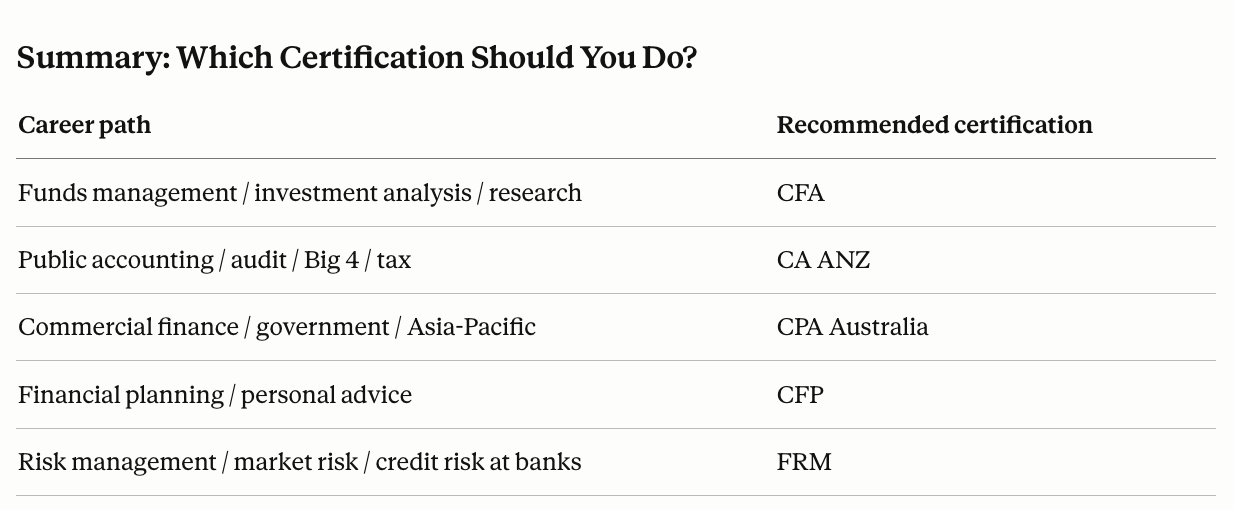
A few practical points before you decide:
Don't rush. If you are a student or less than two years into your career, get work experience and understand which role actually suits you before committing to a certification. They are long and expensive — choosing the wrong one is a real cost.
Certifications complement degrees, they don't replace them. Most of the above require a bachelor's degree as a baseline. The exception is the FRM, where you can sit the exams without a degree — but you still need two years of risk management experience to earn the designation.
Employer recognition matters more than prestige. Research what the firms you want to work for actually expect from candidates at your level. The most prestigious certification is irrelevant if your target employer doesn't value it.
Ongoing learning is built in. All of these certifications have continuing professional development (CPD) requirements once you hold the designation. They are not one-time qualifications — they require ongoing commitment.
If you are still figuring out which finance career path is right for you, read our guide to finance career paths in Australia first. The right certification will become much clearer once you know which direction you're heading.